Scaling DBOS: From Prototyping to Production-Grade Durability

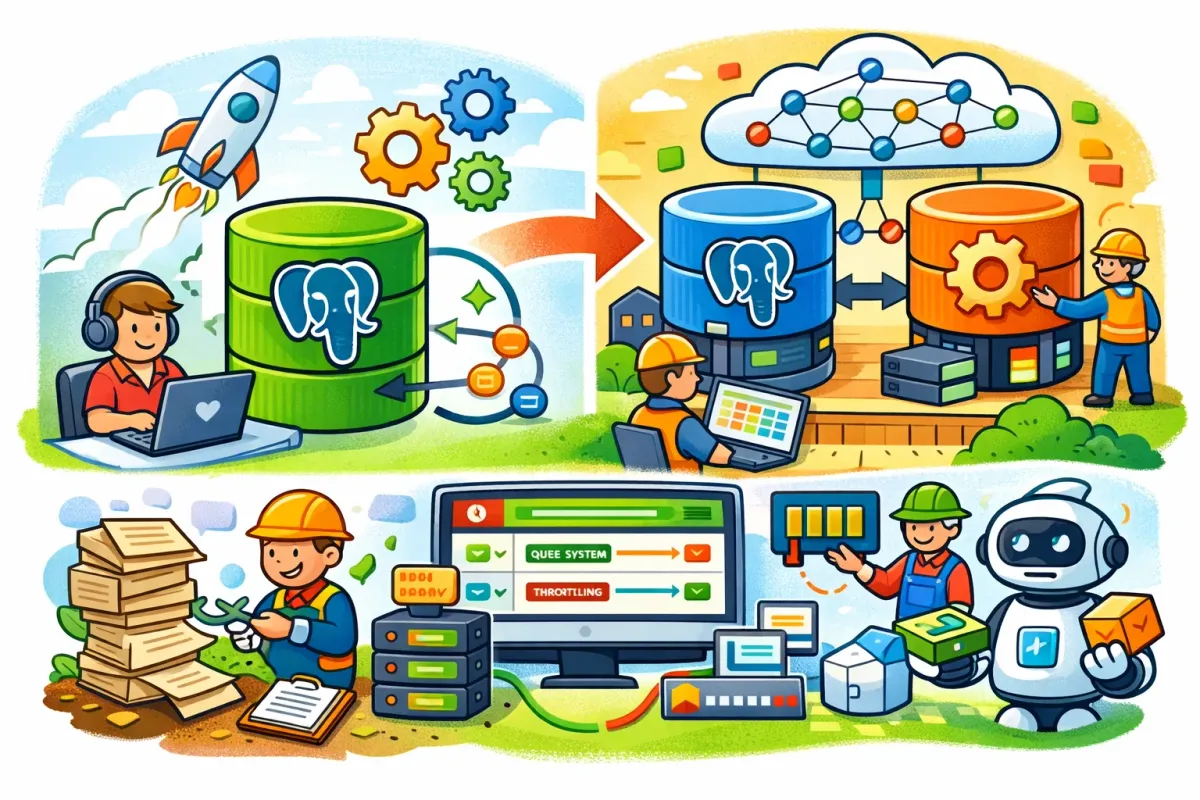
When you first start with DBOS, the magic is in the simplicity: your database is the orchestrator. You don't need to manage a separate cluster or navigate complex RPC configurations—you just use Postgres.
But as your application matures and your workflow throughput hits production-level scale, that same simplicity can become your biggest bottleneck if not handled correctly. Scaling DBOS isn't about throwing more hardware at the problem; it’s about managing the database-backed durable execution engine with the same rigor you apply to your core business data.
If you’re scaling a DBOS-powered application, here are the architectural guardrails you need to move from "it works" to "it survives."
1. The "Split-Brain" Architecture: Dedicated Postgres for _dbos_sys
The most common mistake teams make is keeping their _dbos_sys schema (which stores workflow state, queues, and checkpoints) on the same Postgres instance as their primary application data.
In a high-throughput system, these two workloads compete for the same IOPS, memory, and WAL (Write-Ahead Log) bandwidth.
The Scaling Fix: Move _dbos_sys to a dedicated Postgres instance.
- Why: You get IOPS isolation, independent maintenance cycles (e.g., vacuuming system tables without locking business tables), and the ability to tune storage specifically for high-frequency, small-write workflows.
- The Trade-off: You lose atomic cross-database transactions.
- The Fix: Ensure your business-data writes and workflow initiations are idempotent. If a trigger fails after a business write, your system should be designed to retry the workflow initiation safely.
2. Managing the _dbos_sys Bloat
DBOS durably records every step input, output, and state transition. This is how it achieves its legendary reliability, but it’s also how you fill up your disk in production.
The Scaling Fix: Treat _dbos_sys like a logging database, not a permanent record.
- Retention Policies: Implement automated archival or truncation jobs using
pg_cronor DBOS scheduled tasks to prune finished workflows. - Index Health: Large, unpruned system tables will degrade query performance. Regular maintenance is the backbone of your orchestrator’s performance.
3. The Replay Tax: Determinism is King
DBOS re-runs your workflow code during crashes (the "replay"). If your code is non-deterministic, your application state will drift, leading to workflow failures.
The Developer Mindset:
- Isolate Side Effects: Never perform complex transformations or third-party API calls inside your workflow logic. Wrap them in
@DBOS.stepfunctions. - The "Recorded Result" Pattern: If you need a value like
Date.now()or a random ID inside your workflow, fetch it via a step that records the result to the DB. During replay, DBOS will retrieve the original recorded value rather than re-computing it. - CI Quality Gates: Test your determinism just like you test your business logic. Use tools like Promptfoo to ensure your workflow outputs remain consistent across runs.
4. Preventing Downstream DDoS
DBOS is incredibly fast at scaling horizontally. It can trigger thousands of tasks in milliseconds. If your workflows call an external API (like Stripe or an LLM provider), you will hit their rate limits long before you hit DBOS limits.
The Scaling Fix:
- Distributed Queue Primitives: Use DBOS features like Worker Concurrency Limits and Rate Limiting decorators per step.
- Fair Queuing: If you’re building a multi-tenant app, use partitioned queues to ensure one noisy tenant can't consume your entire outbound API quota.
5. Resource Optimization: Memory and Connections
As you scale to multiple worker nodes, how you handle data and connections determines your stability.
The Developer Mindset:
- Reference, Don't Payload (The Claim Check Pattern): Never pass massive arrays or large JSON objects as workflow arguments. Store large datasets in an S3-compatible object store and pass the reference (URL/Key) to the workflow.
- Connection Pooling: When running many DBOS workers against a split-brain architecture, use PgBouncer or a cloud-native connection pooler (like AWS RDS Proxy) to prevent your Postgres instance from hitting the
max_connectionslimit.
6. Observability: Seeing Through the Replay
In production, "it's slow" is a harder problem to solve than "it's broken."
The Scaling Fix:
- OpenTelemetry (OTel): Enable DBOS's native OTel support to export traces to Honeycomb, Datadog, or Jaeger. This allows you to visualize exactly where a workflow stalled or which step is causing high latency during a replay cycle.
Final Checklist for Production
- [ ] Infrastructure: Is
_dbos_syson a dedicated Postgres instance? - [ ] Connections: Are you using a connection pooler (PgBouncer/RDS Proxy) for high-node counts?
- [ ] Maintenance: Do you have an automated job to prune
_dbos_sys? - [ ] Determinism: Are all side effects encapsulated in
@DBOS.step? - [ ] Throttling: Are outbound API calls protected by rate-limit decorators?
- [ ] Observability: Are OTel traces being exported to a centralized dashboard?
Scaling DBOS is ultimately about moving from seeing it as "a cool library" to managing it as "distributed infrastructure." Once you isolate your system state, implement lifecycle management for your data, and protect your downstream services, DBOS can handle virtually anything you throw at it.